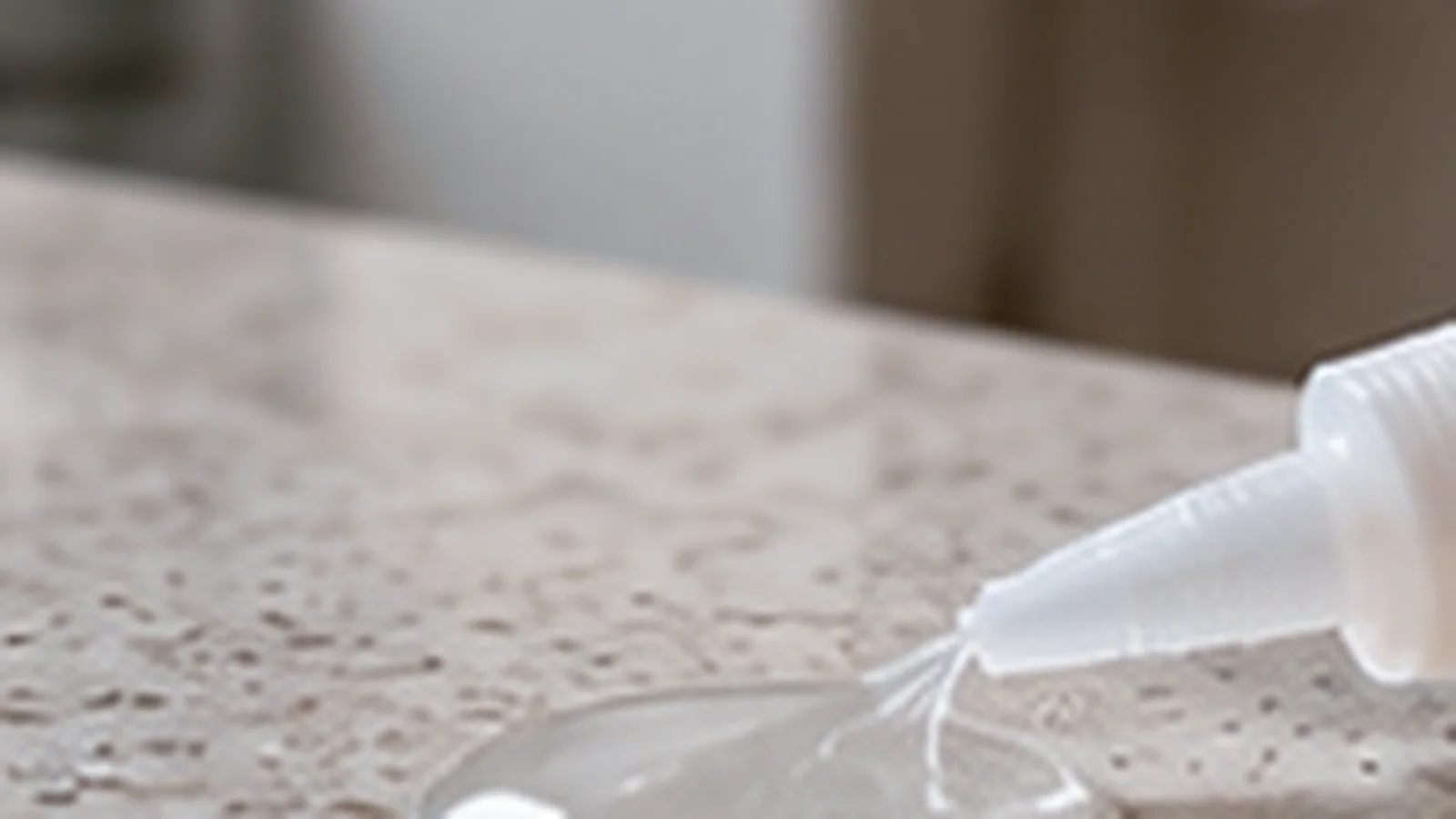
Do not treat quartz like an indestructible stone slab
Engineered quartz combines mineral aggregate with resin and pigments. Cured super glue can often be reduced mechanically, but careless scraping can gouge the finish and untested solvents can affect resin-rich surfaces. The goal is to separate the adhesive from the counter with the least aggressive combination of edge work and chemistry.
What you need
- Plastic scraper or plastic razor-style edge
- Microfiber cloths
- Mild soap and water
- Optional solvent only if the quartz manufacturer allows it
- Eye and hand protection required by the solvent label
Step-by-step
1. Do not smear fresh adhesive
If the glue is still liquid, avoid wiping it across the counter. Follow the adhesive manufacturer’s safety instructions and allow a small bead to cure when that is the safer option.
2. Reduce the cured glue with a plastic edge
Hold the scraper at a shallow angle and work from the outer edge of the adhesive. The aim is to lift glue, not shave the countertop.
3. Clean the remaining film
Wash with mild soap and water. If a thin adhesive haze remains, consult the quartz manufacturer before using a stronger solvent. Test the approved method in an inconspicuous place and keep the exposure localized.
4. Rinse and inspect for finish change
Stop if the quartz becomes dull, sticky, lighter, darker or uneven in sheen. Those changes indicate that the countertop surface is being affected.
Why acetone advice needs context
Acetone is commonly associated with cyanoacrylate removal, but that does not make it a universal quartz recommendation. Engineered-quartz formulas and manufacturer warranties differ. The correct question is not only whether acetone dissolves the glue; it is whether the specific counter tolerates the solvent under the proposed conditions.
How to prevent the problem from coming back
The decision point in “How to Remove Super Glue From a Quartz Countertop” is material-specific: protect the Quartz on the Countertop while testing whether Super Glue is actually removable. Avoid uncontrolled soaking, mixed chemicals, metal scraping and repeated heavy abrasion unless the care guidance for this exact material explicitly allows them. Escalate only one variable at a time so any improvement—or damage—has an obvious cause. A small remaining cosmetic defect is preferable to creating a larger finish change on the Quartz.
For “How to Remove Super Glue From a Quartz Countertop,” this part of the process should be judged against the Quartz on the Countertop, not against a generic cleaning rule. Keep the treatment local and controlled. Remove loose debris first, use the least aggressive compatible step, clear away residue between passes and let the area dry before deciding what comes next. If the mark does not respond, reconsider the diagnosis rather than simply increasing force or dwell time. If the mark stops behaving like removable Super Glue, return to diagnosis before changing tools or chemistry.
When to stop and get professional help
With “How to Remove Super Glue From a Quartz Countertop,” treat the condition of the Quartz and the location of Super Glue on the Countertop as the limits of the method. When to stop is part of the fix: end the treatment if the material changes color, gloss, texture, edge condition or layer integrity, or when the remaining mark behaves like physical damage rather than residue. At that point the next decision is repair, refinishing, replacement or professional assessment—not stronger cleaning. If the mark stops behaving like removable Super Glue, return to diagnosis before changing tools or chemistry.
SurfaceFixLab bottom line
The decision point in “How to Remove Super Glue From a Quartz Countertop” is material-specific: protect the Quartz on the Countertop while testing whether Super Glue is actually removable. Keep the treatment local and controlled. Remove loose debris first, use the least aggressive compatible step, clear away residue between passes and let the area dry before deciding what comes next. If the mark does not respond, reconsider the diagnosis rather than simply increasing force or dwell time. A small remaining cosmetic defect is preferable to creating a larger finish change on the Quartz.
How SurfaceFixLab evaluates this fix
With “How to Remove Super Glue From a Quartz Countertop,” treat the condition of the Quartz and the location of Super Glue on the Countertop as the limits of the method. Product-specific care information matters because coatings, sealers and factory finishes can change the limits of an otherwise familiar material. If the exact finish is unknown, use the more sensitive assumption until a small dried test shows no change in color, gloss or texture. A small remaining cosmetic defect is preferable to creating a larger finish change on the Quartz.
The decision point in “How to Remove Super Glue From a Quartz Countertop” is material-specific: protect the Quartz on the Countertop while testing whether Super Glue is actually removable. Product-specific care information matters because coatings, sealers and factory finishes can change the limits of an otherwise familiar material. If the exact finish is unknown, use the more sensitive assumption until a small dried test shows no change in color, gloss or texture. A small remaining cosmetic defect is preferable to creating a larger finish change on the Quartz.
Before you begin: a five-minute surface check
In “How to Remove Super Glue From a Quartz Countertop,” the useful evidence comes from how Super Glue responds on this specific Quartz and Countertop. Product-specific care information matters because coatings, sealers and factory finishes can change the limits of an otherwise familiar material. If the exact finish is unknown, use the more sensitive assumption until a small dried test shows no change in color, gloss or texture. A small remaining cosmetic defect is preferable to creating a larger finish change on the Quartz.
With “How to Remove Super Glue From a Quartz Countertop,” treat the condition of the Quartz and the location of Super Glue on the Countertop as the limits of the method. Avoid uncontrolled soaking, mixed chemicals, metal scraping and repeated heavy abrasion unless the care guidance for this exact material explicitly allows them. Escalate only one variable at a time so any improvement—or damage—has an obvious cause. If the mark stops behaving like removable Super Glue, return to diagnosis before changing tools or chemistry.
Use an escalation ladder instead of a single aggressive trick
The decision point in “How to Remove Super Glue From a Quartz Countertop” is material-specific: protect the Quartz on the Countertop while testing whether Super Glue is actually removable. Product-specific care information matters because coatings, sealers and factory finishes can change the limits of an otherwise familiar material. If the exact finish is unknown, use the more sensitive assumption until a small dried test shows no change in color, gloss or texture. If the mark stops behaving like removable Super Glue, return to diagnosis before changing tools or chemistry.
The decision point in “How to Remove Super Glue From a Quartz Countertop” is material-specific: protect the Quartz on the Countertop while testing whether Super Glue is actually removable. When to stop is part of the fix: end the treatment if the material changes color, gloss, texture, edge condition or layer integrity, or when the remaining mark behaves like physical damage rather than residue. At that point the next decision is repair, refinishing, replacement or professional assessment—not stronger cleaning. If the mark stops behaving like removable Super Glue, return to diagnosis before changing tools or chemistry.
Know what success looks like
In “How to Remove Super Glue From a Quartz Countertop,” the useful evidence comes from how Super Glue responds on this specific Quartz and Countertop. When to stop is part of the fix: end the treatment if the material changes color, gloss, texture, edge condition or layer integrity, or when the remaining mark behaves like physical damage rather than residue. At that point the next decision is repair, refinishing, replacement or professional assessment—not stronger cleaning. A small remaining cosmetic defect is preferable to creating a larger finish change on the Quartz.
Aftercare matters
For “How to Remove Super Glue From a Quartz Countertop,” this part of the process should be judged against the Quartz on the Countertop, not against a generic cleaning rule. Avoid uncontrolled soaking, mixed chemicals, metal scraping and repeated heavy abrasion unless the care guidance for this exact material explicitly allows them. Escalate only one variable at a time so any improvement—or damage—has an obvious cause. That keeps the method tied to Super Glue on Quartz instead of turning a corrective step into a universal household recipe.
Separate glue removal from countertop cleaning
Cyanoacrylate adhesive behaves differently from food residue. Once cured, it is a hard film bonded to the surface, so the goal is to reduce the glue without scratching or chemically attacking the engineered-stone resin. Start by confirming that the material is engineered quartz and, if possible, identify the manufacturer.
Begin with the least aggressive mechanical step
If there is a raised bead, do not immediately reach for a metal razor. A plastic edge held nearly flat to the surface may remove part of the cured glue with less scratch risk. Work from the edge of the adhesive toward the center and stop if the tool catches or leaves visible marks.
Solvent compatibility is brand-specific
This is where generic internet advice becomes risky. Cosentino’s professional documentation for Silestone, for example, recommends isopropyl alcohol or ethanol for certain silicone and adhesive cleanup and specifically says acetone should not be used on those surfaces. Other engineered-stone manufacturers publish their own approved-product lists. Therefore SurfaceFixLab does not recommend a universal acetone soak for quartz countertops.
If the countertop manufacturer approves a solvent for your exact surface, apply the smallest amount needed to a cloth rather than flooding the counter, keep it away from seams and caulk, respect contact time, and rinse or wipe as instructed.
Do not turn a glue spot into a polished patch
Powdered abrasives, sanding and aggressive scrubbing can change sheen around the repair even if they remove the glue. Engineered quartz is factory-finished; localized polishing can create a patch that reflects light differently from the rest of the countertop.
When to stop
Stop if the countertop becomes dull, tacky, lighter or darker, if resin appears to transfer to the cloth, or if a scraper begins marking the surface. At that point a fabricator or countertop professional is the safer next step.
Prevention
When using cyanoacrylate near a countertop, work over disposable cardboard or a silicone craft mat and keep uncured adhesive away from seams. Fresh accidental drips are easier to manage when they are contained before they spread.
Safety checkpoint for How to Remove Super Glue From a Quartz Countertop: Before you start, test the method on an inconspicuous part of the Quartz and let it dry. Avoid increasing chemical strength or abrasion if the Countertop changes sheen, color or texture. When to stop: if Super Glue remains as a fixed physical change, switch to repair, replacement or professional guidance rather than continuing to clean. For prevention, return to normal material-safe care once the immediate problem is resolved.
Reference set reviewed 2026-09-16. Manufacturer or material-owner guidance is prioritized; exact finish/product instructions take precedence where they differ.