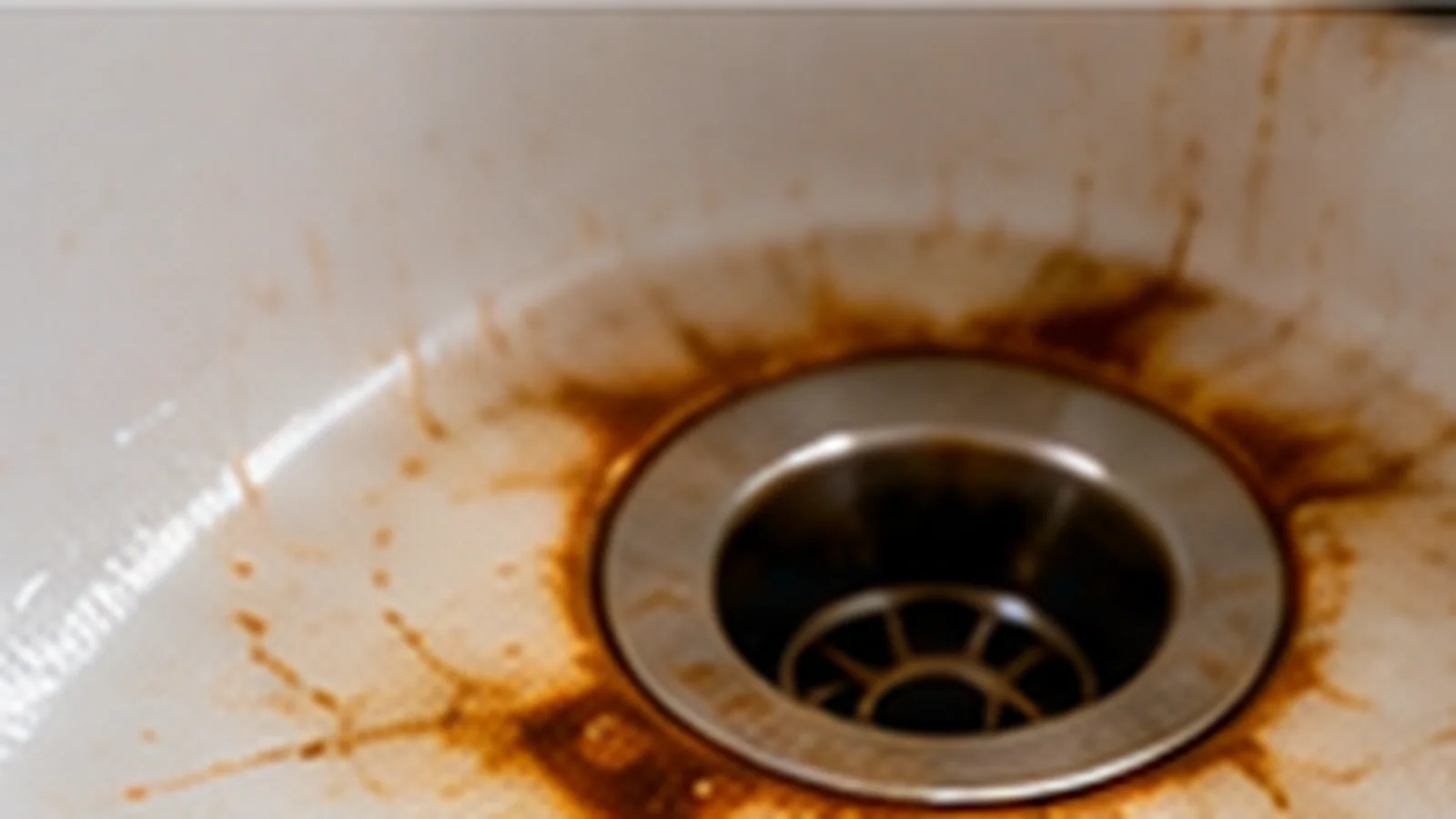
First confirm that the sink is actually glazed porcelain
White bathroom sinks can be vitreous china, porcelain-coated metal, acrylic, composite material or a refinished surface. Rust-removal advice changes when the top layer changes. If the finish has been resurfaced or reglazed, follow the refinisher’s instructions because stronger acids and abrasives can shorten the life of the coating.
Rust-colored marks commonly come from iron in water, a corroding metal object, plumbing components or a can left on a wet ledge. Removing the stain without addressing the source means it may return quickly.
What you need
- Soft microfiber cloth or non-scratch sponge
- A porcelain-compatible rust remover used according to its label
- Clean water
- Gloves when required by the product label
Step-by-step
1. Clean and dry the area
Remove soap film and ordinary dirt first. A clean surface makes it easier to see the actual size of the rust stain and limits unnecessary treatment.
2. Spot-test the chosen product
Follow label dilution and dwell-time instructions. Do not extend contact time simply because a stain is stubborn. Repeated controlled applications are safer than improvising a much stronger concentration.
3. Agitate gently if the label permits
Use a non-scratch sponge or cloth. The glaze is the protective layer; scratching it can create a rougher surface that stains more easily later.
4. Rinse extremely well
Remove all cleaner residue, dry the sink, and inspect under good light. If the stain has not moved, reassess whether it is rust, damage beneath the glaze or discoloration in a refinished coating.
Do not mix rust removers with other cleaners
Household cleaning products can contain acids, bleach, ammonia or other reactive ingredients. Never create your own mixture. Use one product at a time exactly as directed, rinse completely, and ventilate the room as required by the label.
How to prevent the problem from coming back
In “How to Remove Rust Stains From a Porcelain Sink Safely,” the useful evidence comes from how Rust responds on this specific Porcelain and Sink. Avoid uncontrolled soaking, mixed chemicals, metal scraping and repeated heavy abrasion unless the care guidance for this exact material explicitly allows them. Escalate only one variable at a time so any improvement—or damage—has an obvious cause. For this Sink, preserving the finish is a better endpoint than chasing the last cosmetic trace with unnecessary force.
In “How to Remove Rust Stains From a Porcelain Sink Safely,” the useful evidence comes from how Rust responds on this specific Porcelain and Sink. Keep the treatment local and controlled. Remove loose debris first, use the least aggressive compatible step, clear away residue between passes and let the area dry before deciding what comes next. If the mark does not respond, reconsider the diagnosis rather than simply increasing force or dwell time. For this Sink, preserving the finish is a better endpoint than chasing the last cosmetic trace with unnecessary force.
When to stop and get professional help
The decision point in “How to Remove Rust Stains From a Porcelain Sink Safely” is material-specific: protect the Porcelain on the Sink while testing whether Rust is actually removable. When to stop is part of the fix: end the treatment if the material changes color, gloss, texture, edge condition or layer integrity, or when the remaining mark behaves like physical damage rather than residue. At that point the next decision is repair, refinishing, replacement or professional assessment—not stronger cleaning. A small remaining cosmetic defect is preferable to creating a larger finish change on the Porcelain.
SurfaceFixLab bottom line
With “How to Remove Rust Stains From a Porcelain Sink Safely,” treat the condition of the Porcelain and the location of Rust on the Sink as the limits of the method. Keep the treatment local and controlled. Remove loose debris first, use the least aggressive compatible step, clear away residue between passes and let the area dry before deciding what comes next. If the mark does not respond, reconsider the diagnosis rather than simply increasing force or dwell time. For this Sink, preserving the finish is a better endpoint than chasing the last cosmetic trace with unnecessary force.
How SurfaceFixLab evaluates this fix
The decision point in “How to Remove Rust Stains From a Porcelain Sink Safely” is material-specific: protect the Porcelain on the Sink while testing whether Rust is actually removable. Product-specific care information matters because coatings, sealers and factory finishes can change the limits of an otherwise familiar material. If the exact finish is unknown, use the more sensitive assumption until a small dried test shows no change in color, gloss or texture. If the mark stops behaving like removable Rust, return to diagnosis before changing tools or chemistry.
With “How to Remove Rust Stains From a Porcelain Sink Safely,” treat the condition of the Porcelain and the location of Rust on the Sink as the limits of the method. Product-specific care information matters because coatings, sealers and factory finishes can change the limits of an otherwise familiar material. If the exact finish is unknown, use the more sensitive assumption until a small dried test shows no change in color, gloss or texture. For this Sink, preserving the finish is a better endpoint than chasing the last cosmetic trace with unnecessary force.
Before you begin: a five-minute surface check
The decision point in “How to Remove Rust Stains From a Porcelain Sink Safely” is material-specific: protect the Porcelain on the Sink while testing whether Rust is actually removable. Product-specific care information matters because coatings, sealers and factory finishes can change the limits of an otherwise familiar material. If the exact finish is unknown, use the more sensitive assumption until a small dried test shows no change in color, gloss or texture. A small remaining cosmetic defect is preferable to creating a larger finish change on the Porcelain.
The decision point in “How to Remove Rust Stains From a Porcelain Sink Safely” is material-specific: protect the Porcelain on the Sink while testing whether Rust is actually removable. Avoid uncontrolled soaking, mixed chemicals, metal scraping and repeated heavy abrasion unless the care guidance for this exact material explicitly allows them. Escalate only one variable at a time so any improvement—or damage—has an obvious cause. For this Sink, preserving the finish is a better endpoint than chasing the last cosmetic trace with unnecessary force.
Use an escalation ladder instead of a single aggressive trick
For “How to Remove Rust Stains From a Porcelain Sink Safely,” this part of the process should be judged against the Porcelain on the Sink, not against a generic cleaning rule. Product-specific care information matters because coatings, sealers and factory finishes can change the limits of an otherwise familiar material. If the exact finish is unknown, use the more sensitive assumption until a small dried test shows no change in color, gloss or texture. A small remaining cosmetic defect is preferable to creating a larger finish change on the Porcelain.
For “How to Remove Rust Stains From a Porcelain Sink Safely,” this part of the process should be judged against the Porcelain on the Sink, not against a generic cleaning rule. When to stop is part of the fix: end the treatment if the material changes color, gloss, texture, edge condition or layer integrity, or when the remaining mark behaves like physical damage rather than residue. At that point the next decision is repair, refinishing, replacement or professional assessment—not stronger cleaning. A small remaining cosmetic defect is preferable to creating a larger finish change on the Porcelain.
Know what success looks like
In “How to Remove Rust Stains From a Porcelain Sink Safely,” the useful evidence comes from how Rust responds on this specific Porcelain and Sink. When to stop is part of the fix: end the treatment if the material changes color, gloss, texture, edge condition or layer integrity, or when the remaining mark behaves like physical damage rather than residue. At that point the next decision is repair, refinishing, replacement or professional assessment—not stronger cleaning. A small remaining cosmetic defect is preferable to creating a larger finish change on the Porcelain.
Aftercare matters
For “How to Remove Rust Stains From a Porcelain Sink Safely,” this part of the process should be judged against the Porcelain on the Sink, not against a generic cleaning rule. Avoid uncontrolled soaking, mixed chemicals, metal scraping and repeated heavy abrasion unless the care guidance for this exact material explicitly allows them. Escalate only one variable at a time so any improvement—or damage—has an obvious cause. If the mark stops behaving like removable Rust, return to diagnosis before changing tools or chemistry.
Confirm that the surface is intact vitreous china or porcelain
Many white sinks look similar. A factory-glazed vitreous china sink can tolerate care methods that may be inappropriate for acrylic, cultured marble, solid surface or a refinished coating. Sterling/Kohler specifically advises nonscratch cleaning tools for vitreous china and warns against steel wool, wire brushes and abrasive sponge pads. If the sink has been reglazed or refinished, use the refinisher’s instructions instead.
Find the source before treating the stain
Rust can come from iron-rich water, a corroding drain component, a metal can left on a wet ledge or a failing fixture. If the source remains, the stain will return. Check whether the discoloration follows the water path, sits directly below a metal object, or appears around a drain or overflow fitting.
Use a porcelain-compatible rust remover exactly as labeled
Apply only to the stained area and use a soft cloth or nonscratch sponge. Avoid combining rust removers with bleach, ammonia or other household cleaners. Do not assume that mixing products makes them work faster; incompatible chemicals can create hazardous reactions or damage the glaze.
Rinse thoroughly after the labeled contact time and dry the surface. If the stain is lighter but still present, a second labeled application is generally safer than aggressive scrubbing. If there is no improvement, re-check the surface type and source of the discoloration.
Why abrasive tools are a poor trade
A glossy porcelain glaze resists staining partly because it is smooth and nonporous. Deep abrasion can dull or scratch that protective surface. Once damaged, the area may collect soil more easily and become harder to keep clean. A method that removes rust but leaves a permanently rough patch has solved the wrong problem.
When the stain may not be removable
If rust has developed where the glaze is chipped or worn through, staining may be associated with exposed underlying material. Repeated cleaning will not rebuild missing glaze. Likewise, a refinished sink with a failing coating may require repair rather than stronger stain removal.
Prevention
Dry metal containers before placing them on the sink, address corroding hardware, and investigate persistent iron staining in the water supply. Routine drying also helps you see new staining early, when it is easier to remove conservatively.
Safety checkpoint for How to Remove Rust Stains From a Porcelain Sink Safely: Before you start, test the method on an inconspicuous part of the Porcelain and let it dry. Avoid increasing chemical strength or abrasion if the Sink changes sheen, color or texture. When to stop: if Rust remains as a fixed physical change, switch to repair, replacement or professional guidance rather than continuing to clean. For prevention, return to normal material-safe care once the immediate problem is resolved.
Reference set reviewed 2026-09-16. Manufacturer or material-owner guidance is prioritized; exact finish/product instructions take precedence where they differ.