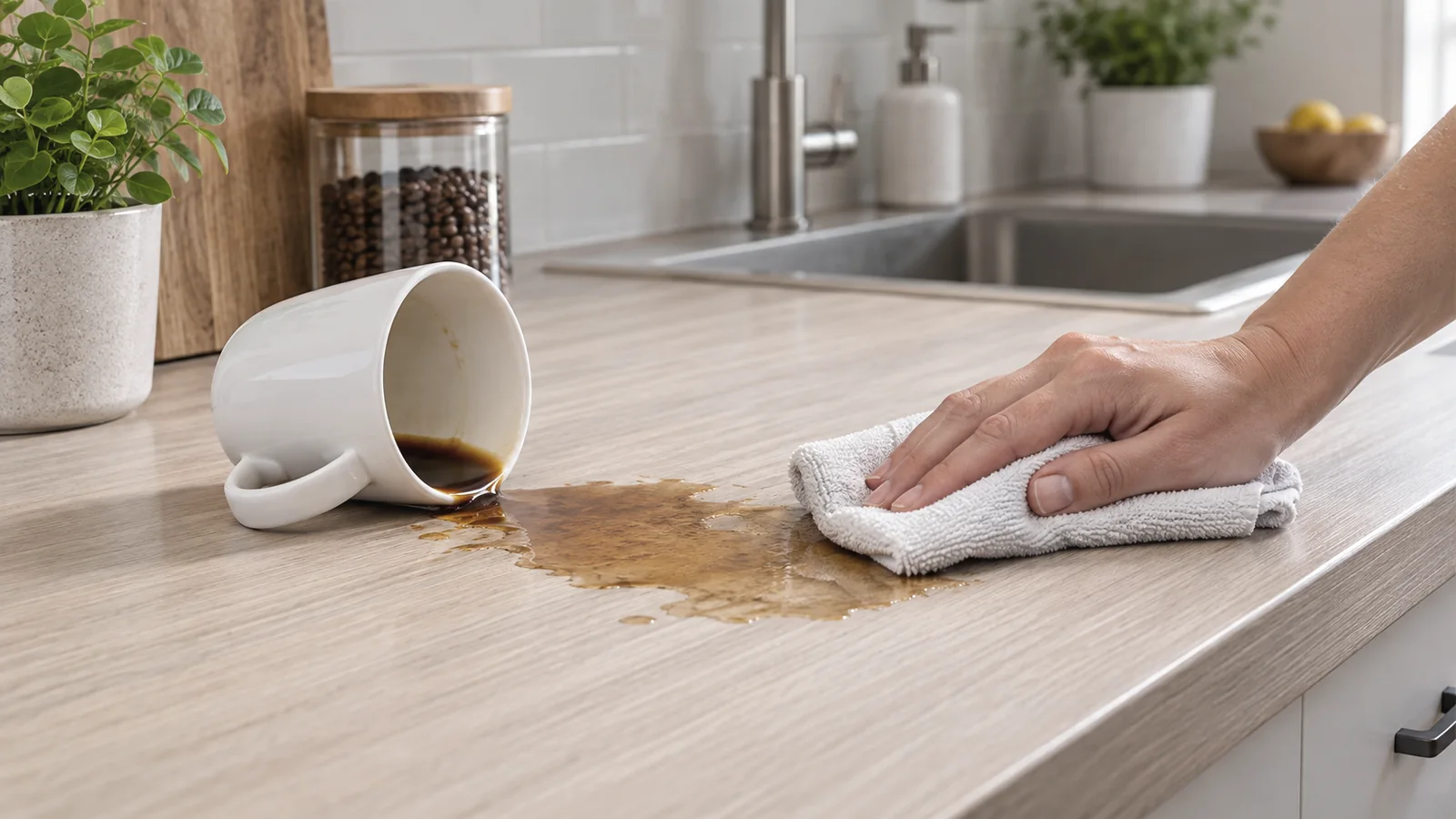
SurfaceFixLab quick answer: Solid-surface countertops are nonporous and renewable, but finish level matters.
Before you start
Confirm the material, finish and object before treating the mark. Similar-looking surfaces can have very different limits. A polished stone, factory coating, laminate wear layer, bathing composite and solid-surface countertop may all react differently to the same cleaner or abrasive. If the manufacturer or model is known, its current care instructions take priority over generalized household advice. In this specific case, preserve the Solid Surface on the Countertop rather than chasing the final trace of Routine Care with stronger chemistry or abrasion.
Photograph the affected area under normal room light before treatment, especially when the surface is expensive or highly visible. Use clean white microfiber cloths where practical so transferred pigment or finish is easy to spot. Remove loose grit first. Grit trapped under a cloth can turn a cleaning step into a scratch. Here, judge the result against the surrounding Solid Surface on the Countertop; reducing Routine Care is useful only while color, sheen and texture remain unchanged.
What you need
- Clean microfiber cloths or another soft tool approved for the surface
- Warm water
- A mild routine cleaner compatible with the material
- The material-specific product described below if routine cleaning is not enough
- Good lighting and a dry cloth for reassessment
Step 1: identify whether the problem is residue or damage
Residue normally changes as it is softened, dissolved or lifted. Damage does not. A stain may fade; a transferred scuff may move onto the cloth; mineral crust may become smoother. By contrast, an etched spot, scratch, swollen edge, worn coating, altered sheen or pitted surface will remain after the contamination has been removed. This distinction is one of the most important safeguards in home surface care. Applied to How to Clean a Solid Surface Countertop Safely, this checkpoint should be read material-first: protect the Solid Surface and change only one variable at a time while assessing Routine Care.
Let the area dry completely before deciding what remains. Many marks look different while wet. If a dull patch disappears when wet and returns when dry, that can indicate a change in surface reflectivity rather than dirt. If an edge has lifted or a core has swollen, no amount of cleaner will flatten it again. For this guide, the practical constraint is the Solid Surface on the Countertop, so escalation should stop before treating Routine Care begins to alter the finish.
Step 2: begin with the lowest-risk method
Start with routine cleaning that the material maker permits. Apply only enough moisture to do the job, keep liquid away from vulnerable seams and controls, and respect the cleaner label’s dilution and contact-time instructions. Work on a small area rather than the whole surface at once. Applied to How to Clean a Solid Surface Countertop Safely, this checkpoint should be read material-first: protect the Solid Surface and change only one variable at a time while assessing Routine Care.
After each pass, remove cleaner residue, rinse when required, dry fully and inspect. Repeating a successful gentle method once is reasonable. Repeating an unsuccessful method with more pressure, longer dwell time or a stronger concentration is not a substitute for diagnosing the problem correctly. For this guide, the practical constraint is the Solid Surface on the Countertop, so escalation should stop before treating Routine Care begins to alter the finish.
Material-specific method
Solid-surface countertops are nonporous and renewable, but finish level matters. Start with warm soapy water or a manufacturer-approved hard-surface cleaner, rinse, and dry thoroughly to avoid a blotchy mineral film. Matte finishes can tolerate more restorative abrasion than semi-gloss or high-gloss finishes. Dark colors also show fine wear more readily. Strong solvents, paint removers, oven cleaners and prolonged chemical contact can damage the material even though ordinary household spills are usually manageable. Keep routine cleaning separate from refinishing: if the surface is clean but visibly scratched or uneven in sheen, switch to the manufacturer’s restoration procedure rather than scrubbing harder.
Step 3: escalate one variable at a time
If routine cleaning clearly improves the problem but does not finish the job, change only one part of the process at a time: chemistry, dwell time or mechanical action. That makes it easier to recognize what is helping and what is beginning to change the finish. A stronger product should be both appropriate for the material and justified by the remaining residue. In this specific case, preserve the Solid Surface on the Countertop rather than chasing the final trace of Routine Care with stronger chemistry or abrasion.
Do not treat internet popularity as evidence that a household chemical is safe. Vinegar, acetone, alcohol, melamine foam, abrasive powders and razor blades can all be useful in narrow situations and damaging in others. The correct question is not “does this remove the mark?” but “does it remove the mark without changing this exact surface?” For this guide, the practical constraint is the Solid Surface on the Countertop, so escalation should stop before treating Routine Care begins to alter the finish.
Stop signals
- The cloth begins picking up surface color or coating.
- A matte finish becomes shiny or a glossy finish becomes cloudy.
- The texture becomes rougher, softer or tacky.
- A seam, edge or plank begins to swell or lift.
- A brushed or directional finish loses its original pattern.
- The remaining defect no longer changes with cleaning.
If one of these signs appears, stop, rinse or neutralize as the product instructions require, dry the area and reassess. Continuing can turn a small cosmetic problem into a larger refinishing or replacement job. Applied to How to Clean a Solid Surface Countertop Safely, this checkpoint should be read material-first: protect the Solid Surface and change only one variable at a time while assessing Routine Care.
What not to do
- Do not mix household cleaning chemicals.
- Do not assume acids are safe on stone or metal finishes.
- Do not use steel wool or aggressive scouring pads unless the manufacturer specifically allows them for that finish.
- Do not flood laminate joints, wood edges, cabinet seams, fixture openings or floor gaps.
- Do not increase pressure simply because a mark is dark.
- Do not keep treating a clean surface as though the remaining defect were still a stain.
When professional repair makes more sense
Professional help becomes reasonable when the remaining problem is structural or finish-related: deep scratches, cracks, large etched zones, heat damage, swollen cores, failed seams, chipped edges, widespread gloss mismatch, coating failure or a defect that affects a large reflected-light area. Professional refinishing can also be the better choice when a technically correct DIY repair would be hard to blend invisibly. For this guide, the practical constraint is the Solid Surface on the Countertop, so escalation should stop before treating Routine Care begins to alter the finish.
Prevention
Once the problem is solved, return to routine care rather than continuing the spot-treatment method. Wipe spills promptly, dry water-prone areas, use trivets and cutting boards where appropriate, keep gritty soil away from glossy finishes and follow the product maker’s maintenance instructions. For recurring mineral or rust problems, address the water source or metal source instead of repeatedly cleaning the symptom. Applied to How to Clean a Solid Surface Countertop Safely, this checkpoint should be read material-first: protect the Solid Surface and change only one variable at a time while assessing Routine Care.
Frequently asked questions
Should I test the cleaner first?
Yes. Test unfamiliar or stronger-than-routine products in an inconspicuous area, follow the label, rinse as directed and let the test area dry completely before judging the result. Here, judge the result against the surrounding Solid Surface on the Countertop; reducing Routine Care is useful only while color, sheen and texture remain unchanged.
How many attempts should I make?
Usually one or two controlled passes are enough to tell whether a method is working. If the mark does not meaningfully change, pause and reconsider the diagnosis instead of escalating pressure indefinitely. In this specific case, preserve the Solid Surface on the Countertop rather than chasing the final trace of Routine Care with stronger chemistry or abrasion.
Why does the mark still show after cleaning?
The remaining change may be physical or chemical damage rather than contamination. Etching, scratches, worn coatings, heat marks, moisture intrusion and altered sheen can remain after a surface is completely clean. Here, judge the result against the surrounding Solid Surface on the Countertop; reducing Routine Care is useful only while color, sheen and texture remain unchanged.
Reference source
Primary material reference: manufacturer or material-owner care guidance. Product-specific instructions, finish restrictions and warranty language take precedence over generalized advice. In this specific case, preserve the Solid Surface on the Countertop rather than chasing the final trace of Routine Care with stronger chemistry or abrasion.
Decision guide for routine cleaning of Corian-type solid surface
Use three observations before choosing the next step. First, note whether the mark sits on top of the surface or changes the surface itself. Second, check whether water changes its appearance; this can help separate loose residue from changes in gloss or texture. Third, look at the edges of the defect. A sharply bounded transferred mark often behaves differently from a diffuse patch caused by moisture, chemistry or heat. Applied to How to Clean a Solid Surface Countertop Safely, this checkpoint should be read material-first: protect the Solid Surface and change only one variable at a time while assessing Routine Care.
Keep the repair proportional to the problem. A small spot should not require treating an entire countertop, wall, floor or shower unless the finish must be blended uniformly. When a local method creates a visible halo or sheen difference, expanding the treated area may make the cosmetic result worse. That is a point to stop and consider professional refinishing. For this guide, the practical constraint is the Solid Surface on the Countertop, so escalation should stop before treating Routine Care begins to alter the finish.
Aftercare checklist
- Remove all cleaner residue.
- Dry the surface fully before final inspection.
- Compare the treated spot from several viewing angles.
- Return to routine maintenance once the defect is resolved.
- Record the product and method that worked for future reference.
SurfaceFixLab launch note for How to Clean a Solid Surface Countertop Safely. Before you start, test a small hidden area and avoid stronger chemistry or abrasion if the finish reacts. When to stop: if color, gloss, texture, coating or the substrate begins to change, stop cleaning and consider professional repair or replacement rather than escalating. Prevention matters after the fix: keep moisture, residue and repeat contact from building up again. Use the Fix Finder, browse surface guidance, or compare problem types before moving to a stronger method.
Reference set verified 2026-09-16. Manufacturer/material-owner guidance prioritized; exact model and finish instructions take precedence.