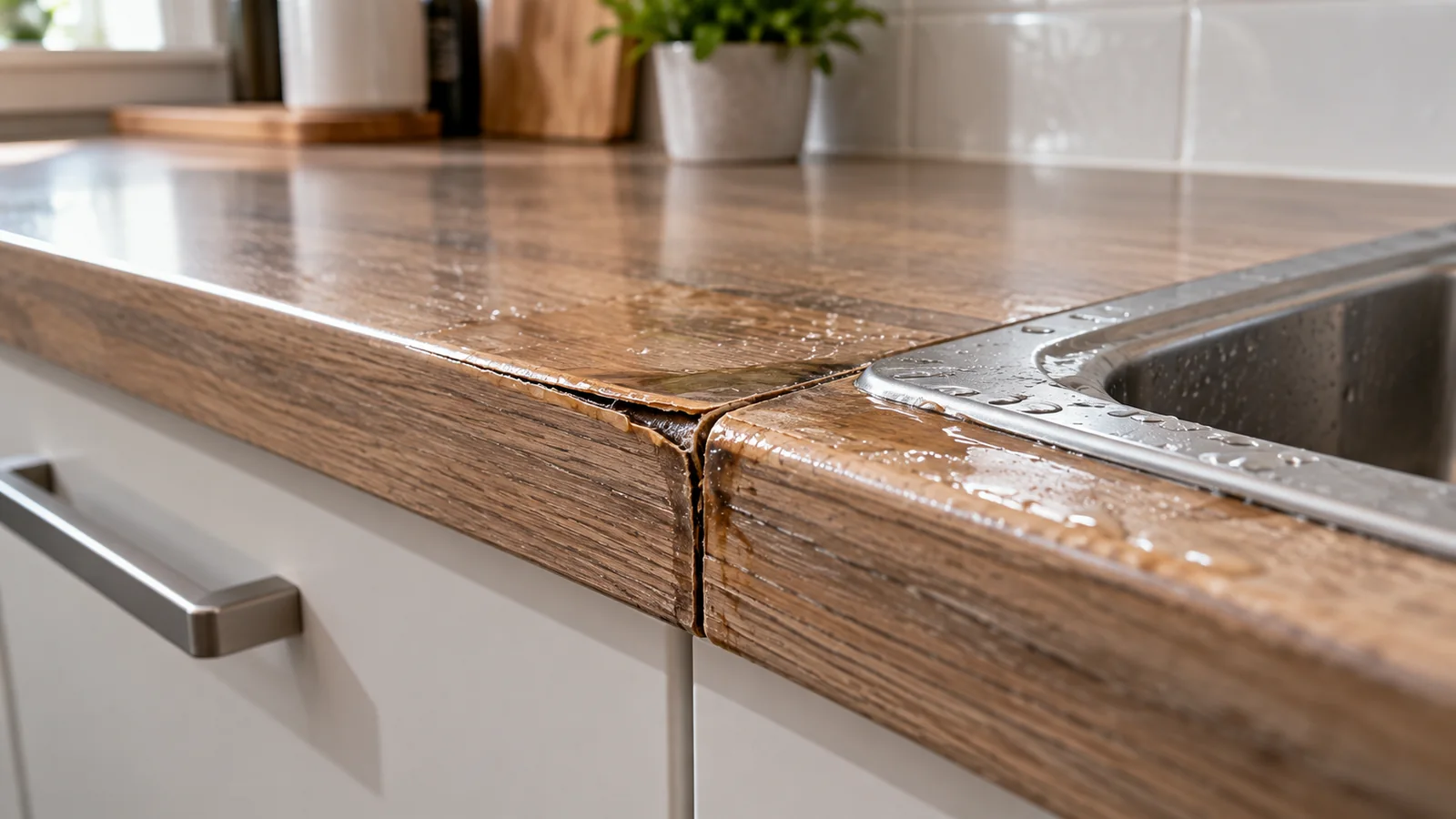
Swelling, lifting, or darkening at a laminate seam often means moisture has reached the substrate, so the first job is to stop the water source rather than scrub the face.
Quick answer
Identify the exact surface and finish first, then begin with the least aggressive method that is compatible with it. Remove loose material, test a hidden area, work in a small zone, and let the surface dry completely before judging the result. For water intrusion, the goal is not simply to make the mark disappear; it is to remove the problem without leaving a new difference in gloss, color, texture, coating integrity, grout condition, seam stability, or wear layer.
Why this problem needs a surface-specific method
Laminate itself is relatively easy to wipe clean, but the core beneath it is much less forgiving when water enters at seams, sink cutouts, edges, or damaged caulk. Formica specifically warns against flooding laminate near seams because moisture can penetrate and swell the substrate.
Many household “hacks” skip this diagnostic step and treat the visible mark as though every surface underneath it reacts the same way. SurfaceFixLab takes the opposite approach: first identify what the surface is made of, then decide whether the mark is residue, staining, wear, chemical change, heat damage, moisture damage, or a structural problem. In this specific case, preserve the Laminate on the Countertop Seam rather than chasing the final trace of Water Damage with stronger chemistry or abrasion.
Before you start
Check the manufacturer, model, finish, coating, sealer, and installation details wherever possible. Look for an owner manual, care sheet, product label, installation record, or manufacturer support page. Photograph the affected area in good light and inspect it from more than one angle. Note whether the mark feels raised, sticky, rough, smooth, soft, swollen, cracked, or indented. Here, judge the result against the surrounding Laminate on the Countertop Seam; reducing Water Damage is useful only while color, sheen and texture remain unchanged.
Protect adjoining materials before using any cleaner. A countertop may meet caulk, painted cabinetry, stainless trim, natural stone, wood, or a sink edge; a tiled area may include grout, sealant, metal profiles, and glass. A product that is acceptable on the main surface may be wrong for the material next to it. Follow label directions for gloves and ventilation, never mix cleaning chemicals, and do not extend dwell times beyond the product instructions. In this specific case, preserve the Laminate on the Countertop Seam rather than chasing the final trace of Water Damage with stronger chemistry or abrasion.
What you need
- Soft, clean microfiber cloths or another manufacturer-approved cloth
- A plastic or non-scratch edge tool only where mechanically appropriate
- Fresh water when permitted by the surface care instructions
- A mild routine cleaner approved for the material
- A dedicated spot treatment only if the first low-risk method is insufficient
- A dry towel and strong side lighting for final inspection
Do not gather the strongest chemicals first. Most damage during household repair comes from escalating too early: abrasive pads on finished surfaces, long solvent exposure, excess water at seams, sharp metal tools, or repeated scrubbing after the removable residue is already gone. Here, judge the result against the surrounding Laminate on the Countertop Seam; reducing Water Damage is useful only while color, sheen and texture remain unchanged.
Step 1: classify the mark
Start by deciding whether you are dealing with material sitting on the surface or a change in the surface. Residue normally has an edge, texture, smear pattern, raised area, or some transfer to a cloth. Damage may be perfectly smooth yet remain visibly different after normal cleaning. Water intrusion can cause swelling, edge lifting, darkening, softness, or a change that grows beyond the original spill area. For this guide, the practical constraint is the Laminate on the Countertop Seam, so escalation should stop before treating Water Damage begins to alter the finish.
Do not keep cleaning if the evidence points to damage. Cleaning cannot rebuild laminate that has blistered, restore a worn factory coating, reverse a deep scratch, flatten a swollen substrate, or replace a failed sealer. Correct classification saves time and prevents an avoidable second problem. Applied to How to Assess Water Damage at a Laminate Countertop Seam, this checkpoint should be read material-first: protect the Laminate and change only one variable at a time while assessing Water Damage.
Step 2: perform the lowest-risk cleaning pass
- Remove loose grit and particles so they cannot scratch during wiping.
- Test the planned method in an inconspicuous spot and allow it to dry.
- Work a small section so dwell time and pressure remain controlled.
- Use light pressure and the normal-care cleaner first.
- Remove all cleaner residue as the care instructions direct.
- Dry the area completely and compare it with the untreated surface under angled light.
If the first controlled pass clearly improves the mark, repeat that same low-risk method once before escalating. Improvement is useful diagnostic information. No improvement is also useful: it suggests either that the soil needs a different chemistry or that the remaining defect is not removable contamination. For this guide, the practical constraint is the Laminate on the Countertop Seam, so escalation should stop before treating Water Damage begins to alter the finish.
Step 3: escalate one variable at a time
Escalation should be deliberate. Change only one factor: the approved spot cleaner, contact time within label limits, or a purpose-designed non-scratch tool. Keep stronger chemistry localized, especially around seams, edges, grout joints, coatings, caulk, labels, and appliance trim. Apply product to a cloth when appropriate rather than flooding the surface. Applied to How to Assess Water Damage at a Laminate Countertop Seam, this checkpoint should be read material-first: protect the Laminate and change only one variable at a time while assessing Water Damage.
After each pass, remove residue and let the area return to normal dryness and temperature. This avoids mistaking temporary wetting, solvent haze, or cleaner film for the original problem. If the treatment changes the finish faster than it changes the stain or residue, stop. For this guide, the practical constraint is the Laminate on the Countertop Seam, so escalation should stop before treating Water Damage begins to alter the finish.
What not to do
- Do not assume vinegar, bleach, ammonia, acetone, melamine foam, steel wool, razor blades, abrasive powder, or heat is universally safe.
- Do not mix cleaners or combine acids with bleach or other reactive products.
- Do not flood laminate seams, wood joints, grout transitions, appliance controls, or other moisture-sensitive edges.
- Do not use a metal scraper on a finished surface unless the manufacturer of that exact material explicitly allows it.
- Do not continue scrubbing once the remaining mark is clearly a burn, scratch, etch, coating loss, swollen core, chip, or other physical damage.
How to tell whether the treatment is working
A successful treatment reduces the original problem while leaving the surrounding surface unchanged. Compare color, sheen, texture, and reflectivity under side lighting. On patterned or brushed finishes, inspect from multiple directions. Stop immediately if the treated area becomes duller, shinier, lighter, darker, tackier, softer, scratched, or rougher than the surrounding material. Applied to How to Assess Water Damage at a Laminate Countertop Seam, this checkpoint should be read material-first: protect the Laminate and change only one variable at a time while assessing Water Damage.
When the visible defect remains after the area is clean and dry, change the diagnosis before changing the chemical. Permanent heat discoloration, etched stone, coating damage, substrate swelling, worn glaze, deep scratches, and finish loss belong in repair or replacement workflows rather than stain removal. Here, judge the result against the surrounding Laminate on the Countertop Seam; reducing Water Damage is useful only while color, sheen and texture remain unchanged.
When DIY should stop
Stop when you cannot positively identify the surface, the manufacturer forbids the planned chemistry, a coating starts to lift, a seam swells, a crack grows, moisture has reached an electrical or structural component, or the fix would require sanding, recoloring, refinishing, heat, aggressive solvent, or material removal beyond routine care. Warranty-covered products are another reason to contact the manufacturer or installer before irreversible work. In this specific case, preserve the Laminate on the Countertop Seam rather than chasing the final trace of Water Damage with stronger chemistry or abrasion.
Professional repair is especially sensible for large visible areas, high-gloss or specialty finishes, natural-stone problems that may require a poultice or refinishing, swollen countertop cores, damaged appliance coatings, or any repair where a cosmetic mistake would be more expensive than the original defect. Here, judge the result against the surrounding Laminate on the Countertop Seam; reducing Water Damage is useful only while color, sheen and texture remain unchanged.
Prevention and aftercare
Return to the ordinary maintenance routine once the spot treatment is finished. Keep surfaces dry where standing water creates mineral or seam problems, use trivets under hot cookware, remove labels before long-term heat exposure, keep grit away from glossy finishes, and repair failed caulk or edge seals before moisture reaches vulnerable substrates. Save the product name and care instructions so the next cleanup starts with known material limits. In this specific case, preserve the Laminate on the Countertop Seam rather than chasing the final trace of Water Damage with stronger chemistry or abrasion.
A specialty treatment should solve a specific problem, not become the default cleaner. Repeated use of stronger chemistry can alter coatings or finishes even when a single controlled application causes no obvious damage. Applied to How to Assess Water Damage at a Laminate Countertop Seam, this checkpoint should be read material-first: protect the Laminate and change only one variable at a time while assessing Water Damage.
Frequently asked questions
Should I test every new product?
Yes when the product is new to the surface, the finish is coated or specialty, the material identity is uncertain, or the cleaner is stronger than the manufacturer’s routine-care recommendation. Let the test area dry before deciding it is safe. For this guide, the practical constraint is the Laminate on the Countertop Seam, so escalation should stop before treating Water Damage begins to alter the finish.
How many times should I repeat a method?
Usually one or two controlled passes are enough to determine whether the approach is working. Repeating an ineffective method many times increases exposure without improving the diagnosis. In this specific case, preserve the Laminate on the Countertop Seam rather than chasing the final trace of Water Damage with stronger chemistry or abrasion.
Why can a stain remain after the surface is clean?
Because the remaining mark may be a physical or chemical change rather than soil. Heat, etching, oxidation, finish wear, moisture intrusion, scratches, and discoloration below a clear coating can all remain after removable residue is gone. Here, judge the result against the surrounding Laminate on the Countertop Seam; reducing Water Damage is useful only while color, sheen and texture remain unchanged.
SurfaceFixLab reference standard
This guide prioritizes manufacturer and material-owner care guidance over generic cleaning advice. Exact model instructions, finish restrictions, warranty language, product labels, and installation documents take precedence. Primary reference: manufacturer/material care guidance. The editorial team stores this reference with the guide so it can be reviewed again when products or care instructions change. In this specific case, preserve the Laminate on the Countertop Seam rather than chasing the final trace of Water Damage with stronger chemistry or abrasion.
Reference set verified 2026-09-16. Manufacturer/material-owner guidance prioritized; exact model, finish and product instructions take precedence.